
How it works

The engine room behind every check

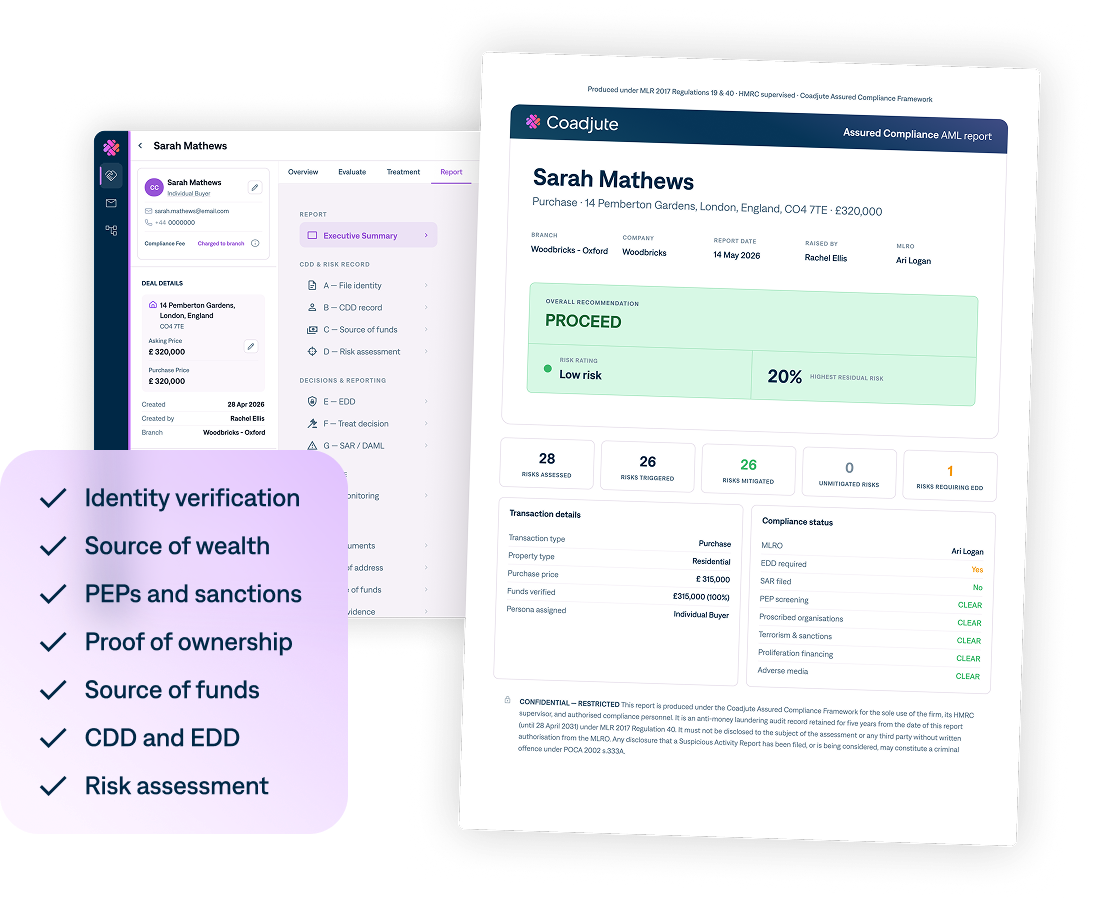
Behind our specialists sits a structured compliance engine: a library of the risks estate agents face, the controls that address them, the policies and procedures behind them, and a Risk Engine that brings it all together for every customer.
2-2

Every AML check is assessed and evidenced the same careful way

  • 42 / Risks

    A library of estate agency risks

    Customer, transaction, geography, delivery-channel and service risks, each rated, with risk acceptance levels and the controls that address it.
  • 140 / Controls

    The right control applied for each risk

    Preventive, detective and corrective controls, each with the evidence it needs and each assigned to the right stage of the check.
  • 233 / Obligations

    In line with HMRC guidance

    Controls linked to the obligations they help meet, drawn from HMRC’s anti-money laundering guidance for estate agency businesses.
See how it works

Every customer has their own live risk register

Scroll to follow one check from start to finish.

  1. Every check starts with who the customer is

    A first-time buyer with a family gift, a company buying an investment, a seller who inherited the property: each brings different risks. The customer’s profile and answers decide which risks apply.

    How Coadjute helps

    The Risk Library holds the AML risks an estate agent faces, across customers, transactions, geography, delivery channels and services. The right ones are applied to each check automatically.

    What it means for you

    We complete your check and apply the risks that matter for your customer, not a one-size-fits-all form.

    Illustrative service view

    Know the customer

    Customer profile
    Identified
    Risks applied
    From the Risk Library

    Illustration · not a live customer record

  2. A live risk register for every check

    Each check gets its own digital risk register: the risks that apply, how serious each one is and what must be in place before the case can proceed.

    How Coadjute helps

    The register is built from the Risk Library and stays with the case, so the reasoning is visible from the first question to the final report.

    What it means for you

    A clear, case-specific picture of risks that your MLRO can examine.

    Illustrative service view

    Build the risk register

    Digital risk register
    Created for this check
    Each risk
    Rated
    Acceptable level
    Set for each risk

    Illustration · not a live customer record

  3. The right controls for each risk

    Every risk has controls that address it (checks that prevent, detect or correct a problem), and each control is linked to the obligations it helps meet in HMRC’s guidance.

    How Coadjute helps

    The Controls Library connects each risk to its controls and the evidence each one needs, so nothing is applied by guesswork.

    What it means for you

    Clear, consistent AML controls, aligned with HMRC guidance, so you can demonstrate compliance, reduce risk and be confident you're audit-ready. 

    Illustrative service view

    Apply the controls

    Controls
    Linked to each risk
    Mapped to
    HMRC guidance obligations
    Evidence
    Defined for each control

    Illustration · not a live customer record

  4. Stronger evidence, lower residual risk

    Our team of UK specialists review the evidence for each control. Only approved evidence counts, and stronger evidence reduces the risk more.

    How Coadjute helps

    The Risk Engine calculates residual risk transparently from the inherent risk and the controls backed by approved evidence. AI helps our reviewers spot inconsistencies, but AI never approves evidence: approval comes from our compliance specialists or fixed, configured rules.

    What it means for you

    Confidence that every AML risk has been properly assessed, with expert-reviewed evidence and clear, documented decisions you can justify to HMRC. 

    Illustrative service view

    Weigh the evidence

    Evidence
    Approved by a reviewer or a fixed rule
    Scoring
    Rule-based and transparent
    AI
    Assists reviewers only

    Illustration · not a live customer record

  5. Proceed, pause or stop, with the reasoning recorded

    Every check ends in a clear outcome. If any risk remains above the acceptable level, the case can’t simply proceed: it needs enhanced checks or an authorised decision. Where there are grounds for suspicion, the outcome says so.

    How Coadjute helps

    Each case moves through Identify, Fact-find, Evaluate, Treat, Report and Monitor. The outcome (Proceed; Consider, for your MLRO’s review; or Stop, where the relationship ends, with a SAR and any DAML prepared where there is suspicion) is recorded with the final risk register in the structured AML report.

    What it means for you

    A recorded outcome, with the evidence and reasoning kept together for the day HMRC asks. Reporting decisions stay with your Nominated Officer.

    Illustrative service view

    Decide and record

    Proceed
    Risk within appetite
    Consider
    Your MLRO reviews, with the evidence and our reasoning
    Stop
    Relationship ends: EDD not completed, or suspicion, with SAR and DAML prepared

    Illustration · not a live customer record

Find out more

Talk to our experts to see how Coadjute can solve your AML challenges

Book a call today
Two colleagues discussing work at a computer in an office.

Your questions, answered

Is the risk score decided by AI?

No. The Risk Engine is rule-based and transparent: inherent risk, the controls in place and the evidence a person has approved. AI assists our reviewers; evidence is approved by reviewers or fixed, configured rules, and people make the decisions.

How does the library relate to HMRC’s guidance?

Controls are linked to obligations drawn from HMRC’s anti-money laundering guidance for estate agency businesses, so you can trace what each control is for.

What happens when a case is higher risk?

If a risk remains above the acceptable level, the case is escalated for enhanced due diligence or an authorised decision, and the outcome is recorded in the AML report. The outcomes are:  Proceed; Consider, where your MLRO reviews the case with the evidence and our reasoning; or Stop, where the relationship with the customer ends because enhanced due diligence was not completed (no suspicion), or because of a suspicion, with a suspicious activity report and any DAML prepared for your Nominated Officer.  All conducted securely to remove any risk of tipping off.

Does this replace our own risk assessment and policies?

No. Your firm must have its own risk assessment and policies, approved by your senior management. The libraries give you a structured, maintained foundation to build from and link your everyday checks to.