

HMRC expects a whole lot more than you think
HMRC’s guidance for estate agents on AML compliance has increased significantly in recent years. It covers your entire business, every buyer and seller, and every record you keep.
So keeping up these days requires a lot more than a generic Digital ID and PEP report.
For most estate agents that's a real challenge, because more time spent on compliance means less time doing what you do best, selling property.
Coadjute is here to help.
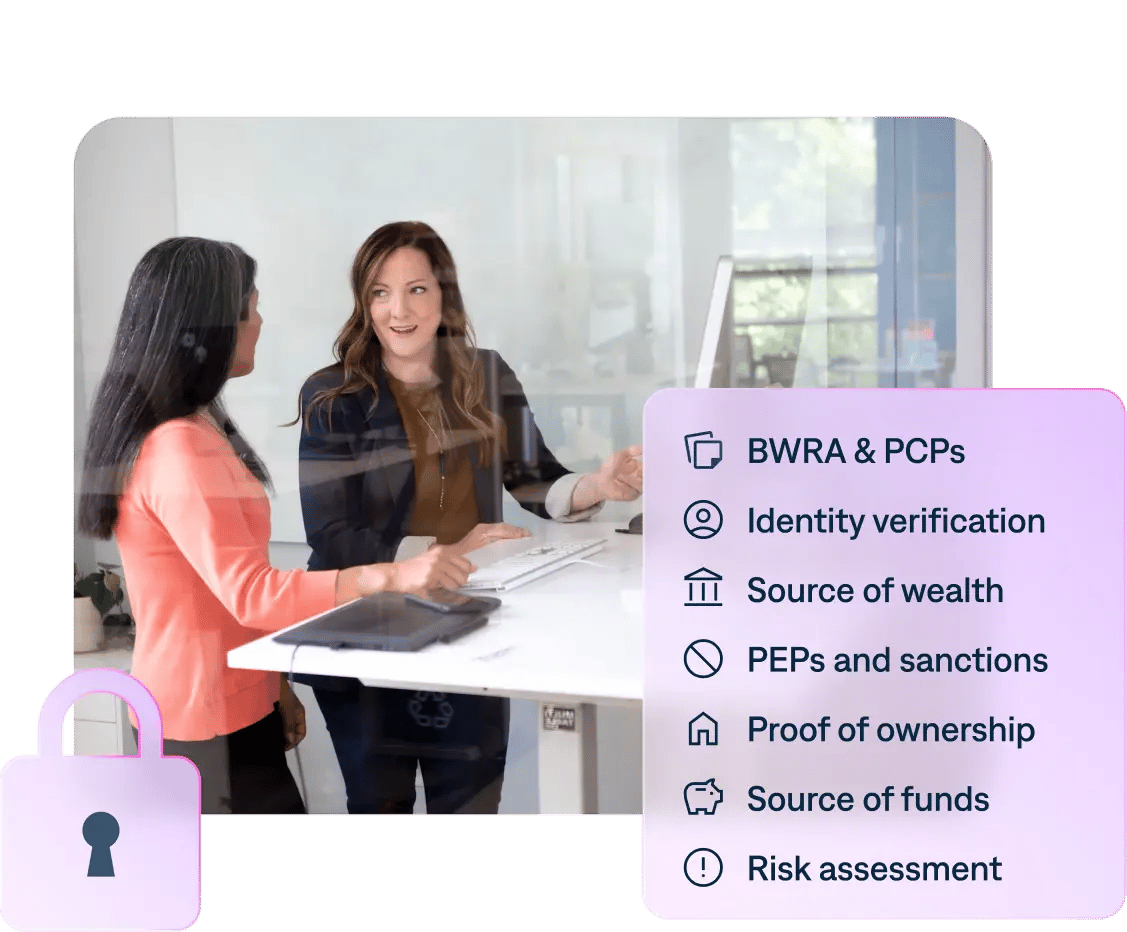
Compliance runs through your entire business
-
01 / Across your firm
It must be tailored to your business
You need an agreed business wide risk assessment, policies, controls and procedures, shared with every colleague and kept up to date. -
02 / For every customer
Cover both sides of every transaction
Your AML compliance must fully check both sides of every sale, not just ID, PEPs and sanctions, but verifying funds, assessing risk and ongoing monitoring. -
03 / In every record
Evidence that stands up in an audit
Checks aren't enough. You also need to prove training, case evidence and the reasoning behind decisions, kept for five years and ready when HMRC asks.
The new reality.
The new era of AML compliance
Click on any section below to see what HMRC expects from every agency, what it takes to do it yourself and how Coadjute can help.
1
Your business-wide risk assessment
HMRC expects
A written assessment of money laundering, terrorist financing and proliferation financing risk across customers, services, channels and geography, taking HMRC’s own risk assessment into account, fully adapted, reviewed at least annually and kept for five years.
Doing it yourself
Research, scoring, sources, annual reviews, trigger reviews and version control, owned by your MLRO.
Coadjute does it
Your risk assessment built digitally on the platform from the AML Standards Library, with versions kept and, coming soon for MLROs, Insights from your own checks.
2
Your policies, controls and procedures
HMRC expects
Written policies covering customer checks, PEPs, suspicious activity, training, records and monitoring, approved by senior management at every change and shared with every colleague.
Doing it yourself
Drafting, approving, communicating and re-sharing every year, with proof.
Coadjute does it
A customisable policy library, with controls and procedures linked to every check and shared through the Training Hub.
3
Your nominated MLRO and training
HMRC expects
A Nominated Officer appointed and HMRC told of the appointment within the time the Regulations set; every relevant colleague trained at the start and regularly after (most firms at least annually), with records.
Doing it yourself
Running courses, testing understanding, keeping records and refreshing when anything changes.
Coadjute does it
Role-based training, assessments and certificates, and case evidence your Nominated Officer can examine.
4
Checking every buyer and seller
HMRC expects
Both parties verified before the relationship begins; name, photo, date of birth and address verified; documents checked for genuineness; beneficial owners identified.
Doing it yourself
Hundreds of checks a year, each timed around the sale, including companies, trusts and representatives.
Coadjute does it
Our specialists run and review every check, with guided digital ID and Agent Assisted for customers who need help.
5
Source of funds and wealth
HMRC expects
Source of funds always scrutinised and traced back in full on a purchase; knowing where the money came from – a UK bank account is not enough.
Doing it yourself
Reading statements, matching gifts, judging plausibility and chasing the gaps.
Coadjute does it
Specialists trace the money, including giftors and gifts funded by other gifts, and follow up until it’s complete.
6
Enhanced due diligence and PEPs
HMRC expects
EDD for PEPs, high-risk countries, false documents, and complex or unusually large transactions, unusual patterns, or no apparent economic or legal purpose; senior-management approval before a PEP relationship.
Doing it yourself
Rare cases needing rare expertise, arriving when your team is busiest.
Coadjute does it
Specialist enhanced due diligence with the reasoning recorded, and PEP decisions brought to you with the evidence.
7
Ongoing monitoring
HMRC expects
Monitoring throughout the relationship, keeping information current and acting on changes.
Doing it yourself
Tracking every live sale and noticing when something changes.
Coadjute does it
Ongoing monitoring and re-screening throughout the relationship (at least 12 months), with changes escalated to specialists.
8
Suspicious activity and DAMLs
HMRC expects
Internal reports to your Nominated Officer; SARs where there are grounds; a DAML before proceeding; no tipping off; reasons recorded either way.
Doing it yourself
Judgement under time pressure in a live chain, without alerting anyone.
Coadjute does it
Red flags escalated, a clear Proceed, Consider or Stop outcome, and SAR preparation and DAML support for your Nominated Officer.
9
Records kept for five years
HMRC expects
Evidence and enough to reconstruct each sale, kept five years after the relationship ends and produced on request.
Doing it yourself
Files across inboxes, drives and systems, and two retention clocks.
Coadjute does it
A structured AML report and complete history for every customer, all in one place.
10
Relying on others
HMRC expects
Using a third party doesn’t remove your responsibility; you must be able to examine, interpret and decide on what they provide.
Doing it yourself
Accepting pass/fail results you can’t explain.
Coadjute does it
Every decision explained (risks, controls, evidence and outcome) so you can examine the work.
HMRC assumes you have a complete compliance department
-
An MLRO with time to do the job
-
Analysts for every check
-
Source-of-funds and EDD expertise
-
A trainer and a training record
-
Full oversight across the business
-
Someone tracking HMRC

Compliance is already one of your biggest overheads.
- £16k+
- average annual compliance cost for an independent agency
- £70k+
- for a medium-sized firm, and £200,000+ for an enterprise
- 3 hrs
- spent on AML compliance for every transaction
- £46k
- average salary of a property compliance specialist
Source: Credas, The real cost of compliance in the property sector (2025), drawing on HMRC registration data. Coadjute’s own 2026 analysis found the figure varies widely with branch size and how much enhanced due diligence a branch sees, which is why the calculator below starts from your own volumes rather than an average.
How compliant are your current processes?
Talk with an expert
Your questions, answered.
Can we just use an ID app?
An ID check is one part of the job. HMRC also expects source of funds to be scrutinised on purchases, beneficial owners identified, higher-risk cases investigated, and a firm-wide risk assessment, policies, training and records behind it all.
If we use Coadjute, are we still responsible?
Yes. HMRC is explicit that responsibility stays with your firm. Coadjute does the work, keeps it consistent and puts the evidence and decisions in front of you, so you can show how your controls operate.
When do the checks need to happen?
HMRC’s guidance says the seller must be verified when they sign your terms, before marketing, and the buyer’s checks must be complete when their offer is accepted, ideally before the offer is accepted, with source of funds considered on every purchase and scrutinised where the risk requires (regulation 28(11); HMRC’s sector assessment says it “must always be scrutinised”). Your agency decides how this fits its process.
Do we still need a Nominated Officer?
Yes. Your firm must appoint one and tell HMRC. Coadjute supports them with case evidence, escalations and training records; reporting decisions stay with your Nominated Officer.
When is enhanced due diligence required?
Where the Regulations and HMRC’s guidance say the risk is higher: a politically exposed person or their family or close associates; a customer or transaction connected to a high-risk third country; where false or stolen identity documents have been provided; and complex or unusually large transactions, unusual patterns of transactions, or transactions with no apparent economic or legal purpose. Beyond those triggers, your own risk assessment decides when a case is higher risk. Enhanced due diligence is a judgement on the facts of the case, not a blanket rule for every large sale, which is why each enhanced case on our platform records the trigger that applied.
Trusted by reputable agents across the UK
Coadjute is used by serious property professionals and backed by major UK financial institutions. When compliance is reviewed, the platform speaks for itself.
-
We are so pleased to have changed all of our AML over to Coadjute. Not only has it saved us time, it also saves us money, which is brilliant! We work with Adam and he is always on the other end of the phone if we need him. Great company and great team.
Josie Fletcher - Foundation Estate Agents -
We have been working with Coadjute for some time and continue to have a great experience - would recommend.
Sean Moore - Hunters -
Since we switched to Coadjute the whole AML process has improved beyond our expectations. Can’t speak highly enough of the team and the efficiency within the company.
Mark Pesci - Fine & Country
Some of our clients